For parents · K–12 education
When a teacher talks to your child, there is a license behind that conversation, a supervisor, and an insurer.
When a generative AI system does the same, those structures may not exist.
This page explains what your school is legally required to provide, why generative AI creates a new category of risk, and what you can do about it.
What changed
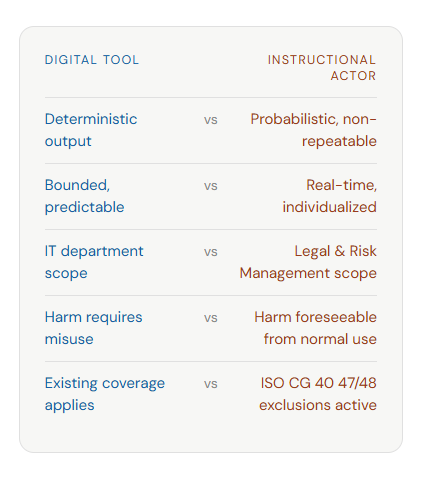
Schools are governing a generative AI instructional actor using a digital tool framework. That gap is where liability lives.
A calculator gives the same answer every time. A traditional search engine retrieves and ranks pre-existing third-party content. A generative AI system produces new individualized content at runtime. These are deterministic tools, bounded, predictable, governed by what a user puts in. Schools have frameworks for these. Those frameworks were not designed for what generative AI does.
Generative AI produces real-time, individualized responses that answer questions, guide thinking, and influence a child's understanding and meaning-making. These outputs cannot be previewed or reliably predicted in advance, and they are not required to reflect school policy or curriculum goals. In these conditions, the system is no longer functioning as a traditional tool, it is functioning as an instructional actor, generating individualized content in real time, without human review and without being bound to what the school has approved.
What this means for your child
A school can choose textbooks or devices. What it cannot do is hand your child something harmful and expect you to intercept it.
A school would not give a child a book with some of it containing harmful or inappropriate content and expect the parent to intercept it before the child reads it. The same standard applies in the digital world. When a district places a device in your child's hands with a generative AI system accessible on it, the content that system generates is happening on district equipment, through access the district made available to your child, under the district's custodial responsibility.
What makes generative AI categorically different from a textbook or from any prior digital tool — is that harm is foreseeable not from misuse, but from normal use.
The system generates probabilistic outputs in real time, with no internal signal that harm has occurred, and no legally binding way to stop it, register it as harm, or prevent it from recurring. The vendors whose systems produce these outputs have contractually disclaimed responsibility for them. Insurers have begun issuing endorsements — ISO CG 40 47 and CG 40 48 — that specifically exclude coverage for harms arising from generative AI outputs.
Your school's legal obligations
Signing an AUP (Acceptable Use Policy) does not transfer the district's duty of care to you - it cannot with GenAI.
When you enroll your child in school, the district assumes a legal duty to act in your place, a doctrine known as in loco parentis, meaning "in the place of a parent." Once a school takes custody and control of your child, it steps into a guardian role. Courts have recognized that schools must supervise and protect students from foreseeable harm to both their physical and emotional well-being. This obligation attaches the moment your child is in the school's care, on the school's equipment, using systems the school has made accessible.
Your district may ask you and your child to sign an Acceptable Use Policy before accessing school-issued devices. That signature establishes that your child was informed of the rules. What it cannot do is transfer the district's duty of care back to you. Courts have consistently found that a parent cannot validly sign away a minor child's personal injury claim, and that waivers purporting to release injury claims against a school on behalf of a minor are unenforceable. An AUP defines responsibilities, it does not and legally cannot relieve the district of its obligation to ensure the systems it places in front of your child are governed in a way that maintains its duty of care.
The question of whether the district has established the structural conditions required to remain within its duty of care obligations for generative AI interactions is one every parent has the right to ask and one every district has the obligation to answer.
Questions to submit in writing
Direct your request to Legal and Risk Management (not IT).
These questions are drawn from the Institutional Accountability Framework's pre-deployment governance sequence. They are designed to surface whether the structural conditions for accountability are in place before an incident occurs, not after. Submit them in writing and request written responses. These questions answer basic questions in a harm event: such as a.) what happened b.) why it happened c.) who’s responsible and d.) what did the school do to prevent it from happening again?
You may attach the IAF. IT cannot answer these questions. Legal and Risk Management can.
1 Accountability
Has the district identified the responsible entity for generative AI content delivered to students in real time on school-issued devices, district accounts, or approved platforms? If the district identifies a vendor, please provide the contract language showing that the vendor affirmatively accepts responsibility for student-facing outputs.
2 Reconstruction
Can the district fully reconstruct all AI interactions, including prompts, outputs, system-suggested prompts, system-completed or edited inputs, session history and retained context for the full sequence of the interaction if an incident occurs?
Generative AI outputs are non-repeatable. Without complete, attributable logs including any stateful context the system retained, a district cannot investigate what was said, to whom, or under what conditions. Partial logs do not satisfy this condition.
3 Insurance coverage
Has the district received written confirmation from its insurer, risk pool, self-insurance authority, or other responsible financial entity that student use of accessible generative AI is affirmatively covered under current policy or risk-financing terms, including in light of emerging generative-AI exclusions such as ISO CG 40 47 and CG 40 48?
If no such written confirmation exists, who has formally accepted financial responsibility for harms arising from student-facing generative AI use?
4 Access and Approval
Which generative AI systems are students able to access on school-issued devices, district accounts, district browsers, approved platforms, or embedded features, and which of those systems has the district formally approved for student use?
5 Supervision and Parent Authority
If the district allows student access to generative AI outside direct classroom supervision, what tools, controls, notice, training, logs, or opt-out options has the district provided to parents so they can meaningfully supervise that use?
6 Change Control
What process does the district use to review and approve material changes to student-facing generative AI systems, including changes made by the vendor, embedded platform, underlying model provider, safety layer, search/retrieval layer, memory settings, logging terms, or liability terms?
When you receive a response, forward it to DCCF at info@digitalchildhoodcouncil.org. We can help you assess whether the response addresses the governance questions or requires follow-up or use the Rubric here for guidance.
What the vendors are telling you - and what they are not
As of May 2026, the terms of the major vendors tell the same story. Microsoft's Copilot terms state the product is 'for entertainment purposes only' and that users should 'use Copilot at your own risk.' Google's Gemini documentation acknowledges the system 'may sometimes produce content that violates our guidelines.' Khan Academy's Khanmigo safety page states they use moderation technology to detect interactions that 'may be inappropriate, harmful or unsafe', an acknowledgment that such interactions are an anticipated occurrence, not a theoretical one. Schools operating through the 2025–2026 school year have had access to this information. Under established duty of care principles, foreseeability does not require that harm has already occurred, it requires that a reasonable institution knew, or should have known, that harm was possible.
Some vendors will point to safety filters and moderation systems designed to prevent harmful responses. That may be true. But for parents and schools, only two questions actually matter:
When harm arises from your product (Gen AI), do you cover it?
And is that coverage commensurate with the harm your product can cause a child?
Parents can start by asking those two questions to your district in writing / by email before your child's next interaction with one of these systems. The IAF provides the structural framework for what accountable deployment requires.