For risk managers · School district liability
Generative AI in schools is a new category of institutional exposure, and most districts don't know it yet.
This page is for school district risk managers and their legal counsel. It identifies the structural conditions that create unresolved liability when students interact with generative AI systems on school-issued devices, and points to the framework that defines what accountable deployment requires.
THE EXPOSURE
01
Policy authority dissolves within the interaction
A district can write a policy. It cannot enforce that policy at the moment a generative AI system responds to a student. There is no mechanism that binds institutional authority to content before it is delivered to a student.
02
No way to stop or register harm in real time, and no binding obligation to correct it
Generative AI outputs are probabilistic and non-repeatable. When a harmful interaction occurs, nothing stops it, registers it as harm, or prevents it from recurring. If an incident is later investigated, the district may be unable to reconstruct what the system said, to whom, and under what configuration. And even where vendors provide harm reporting tools, no contractual mechanism binds them to correct the underlying condition or prevent recurrence
03
Vendor disclaimers define what vendors won't cover, not what the district still owns
Liability disclaimers in vendor agreements transfer risk without resolving it. The district's duty of care obligation to students does not transfer with them.
The insurance signal
In 2026, insurers introduced policy endorsements that specifically exclude liability coverage for harms arising from generative AI outputs, including bodily injury and property damage claims.
The operative question for every school district risk manager: has student use of generative AI on school-issued devices been explicitly evaluated and affirmatively covered within your current underwriting structure? An AUP is not a coverage determination.
The structural gap
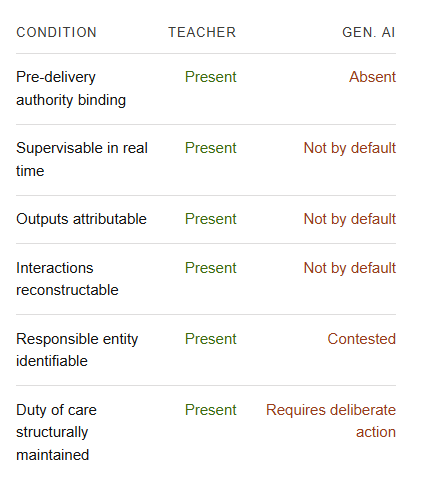
Schools are governing a generative AI instructional actor using a digital tool framework. The conditions are not the same.
When a teacher interacts with a student, the institution has supervisory authority over that interaction before, during, and after it occurs. The outputs are attributable. The responsible entity is identifiable. Accountability is structurally present.
Generative AI deployed in the same instructional role does not carry those properties by default. They have to be established deliberately, before deployment, not assumed, and not delegated to a vendor.
Institutional Accountability Framework · IAF
What has to be structurally true before generative AI enters the classroom.
Generative AI systems have no internal mechanism that binds content to institutional authority before a student receives it. The IAF defines what has to be true structurally for a district to remain within its duty of care obligations: supervision that is enforceable, interactions that can be properly attributed and are reconstructable, and a responsible entity that can intervene, investigate, and be held liable when harm occurs. Vendor disclaimers define what the vendor won't cover. The IAF defines what the district still owns.
Evaluates
Whether supervision, attribution, and reconstructability are structurally present in the deployment
Defines
The pre-deployment sequence required to establish institutional accountability before access is granted
Identifies
The governance gap that vendor liability disclaimers do not resolve and AUPs cannot substitute for
Audience
Risk managers, legal counsel, underwriters, school board members, district administrators
Recommended next steps for district risk managers
The IAF is designed to be read alongside legal counsel. It is not a checklist, it is a structural framework that surfaces whether the conditions for accountable deployment are in place. We recommend the following sequence.
Read the IAF. Identify whether each structural condition it defines is currently met in your district's generative AI deployments.
Share the IAF with legal counsel. The framework is designed to support legal review of vendor agreements, AUPs, and district liability posture.
Confirm with your insurer that student-facing generative AI interactions are explicitly covered - not assumed covered under current policy terms, in light of ISO endorsements CG 40 47 and CG 40 48.
Digital Childhood Council of Florida
An independent policy organization focused on AI governance and institutional accountability in K-12 education. Palm Beach County, FL
Audiences
Risk & Insurance
Schools
Policymakers
Parents